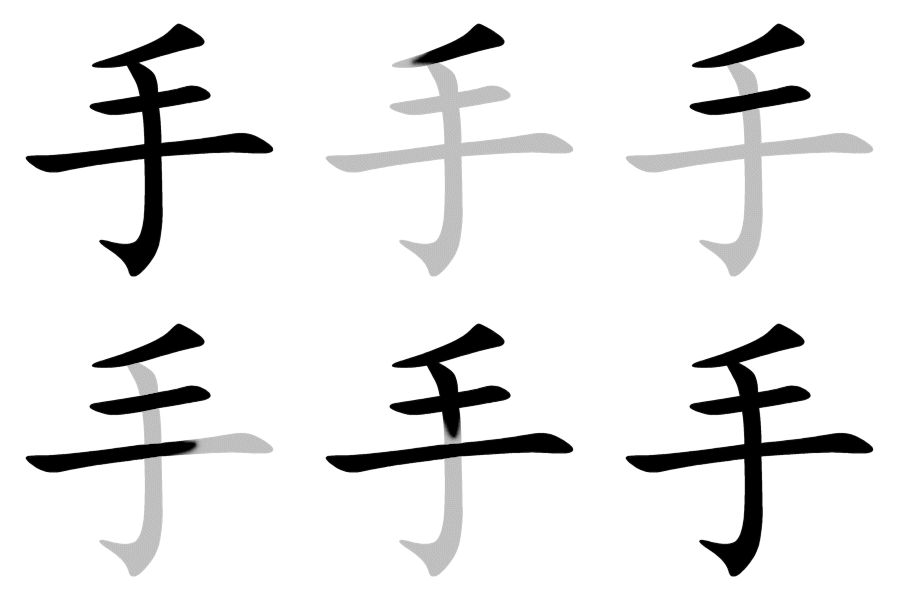
手
- hand;
It can also refer to skill, method, or person (as in an agent or performer of an action).
Etymology
It is a pictograph that was formed by imitating the shape of a hand.
Usage in Korean
手 is the principal radical for the concept of the hand.
When used as a radical, it often takes the variant form 扌 and is written on the left side of a character.
Characters with the 手/扌 radical typically carry meanings related to:
• handcraft, dexterity, skill,
• manual action, method, means,
• or a person performing an action.
Alternative forms
Similar shape characters
If enlarged, 扌 resembles 才 (meaning “talent” or “ability”), which is also classified under the 手 radical.
However, 才 and 扌 have different origins despite their similar shapes, so 扌 is sometimes called “jaebangbyeon” (재방변), meaning “talent-side radical.”
A similar case exists with the 肉 (meat) radical, which appears as 月 (moon) when used as a component, and is then called “육달월” (meat-moon-shape).
Characters with 手
- 扱–to handle, to gather, to insert, to affect
- 扶–to help, assist
- 批–to criticize, to comment, to strike, to slap, to approve, to endorse
- 技–skill, ability, technique, craft, art, workmanship
- 抄–to extract, to copy, to select, to raid
- 把–to hold, to grasp, to take in the hand
- 抑–to press down, restrain, suppress, control
- 投–to throw, to cast, to submit
- 抗–to resist, to oppose, to defy, to withstand, to confront
- 折–to break, snap, bend
- 抛–to throw, to toss, to hurl
- 承–to receive, to bear, to undertake, to inherit, to continue, to succeed, to support, to carry
- 披–to open, to spread out, to unfold
- 抱–to embrace, to hold in one’s arms
- 抵–to resist, to oppose, to withstand, to reach, to offset, to be worth
- 抹–to wipe, to erase, to rub off
- 押–to press, to sign, to detain
- 抽–to pull out, to extract, to draw, to select
- 拂–to brush off, to shake off, to dust, to wave away, repel
- 拉–to pull, to drag, to seize
- 拍–to clap, to pat, to strike lightly
- 拒–to block, to resist, to refuse, to reject
- 拓–to expand, to open up, to broaden, to print, to make a rubbing, to engrave, to carve
- 拔–to pull out, to extract, to uproot, to remove, to withdraw, to surpass, to excel
- 拗–to twist, to bend, to force, stubborn, contrary
- 拘–to seize, to detain, to arrest, to restrict, to restrain, to be bound by
- 拙–clumsy, awkward, unskillful, inept
- 招–to call, to summon, to invite, to beckon
- 拜–to bow, to pay respects, to worship, to salute, to pray, to visit
- 括–to bind, to gather, to include, to summarize
- 拭–to wipe, to clean, to wash away
- 拾–to pick up, to gather, to collect, to find
- 持–to hold, to grasp, to carry, to maintain, to sustain, to persist
- 指–to point, to indicate, finger
- 按–to press, to push, to calm, to massage
- 挑–to raise, to provoke, to stir up, to lift, to poke, to incite
- 撓–to bend, to warp, to curve, to twist
- 捧–to hold up with both hands, to revere, to serve
- 捨–to discard, to abandon, to give up
- 掃–to sweep, to clear away, to eradicate
- 授–to give
- 排–to push away, to expel, to arrange in order, to line up, to reject
- 掘–to dig, to excavate, to hollow out
- 掛–to hang, to suspend, to attach
- 採–to gather, to pick, to pluck
- 探–to search, to look for, to probe, to explore
- 接–to connect, to join, to come into contact, to receive, to engage
- 推–to push, to infer, to postpone
- 措–to place, to set, to put down
- 描–to draw, to depict, to sketch
- 掌–palm of the hand, to hold in the hand, to manage, to govern
- 揄–to mock, to ridicule, to tease
- 提–to lift, to raise, to carry in the hand, to bring up
- 揚–to raise, to lift up, to scatter, to soar, to praise
- 換–to change, exchange, substitute, replace
- 握–to grasp, to hold firmly, to seize
- 揭–to lift high, to raise, to post, to expose
- 揮–to wave, to wield, to scatter, to command, to direct
- 援–to help, to assist, to aid
- 揶–to tease, to mock, to jeer
Words that derived from 手
- 手 (Q)
- ⿻ 𠂌 一