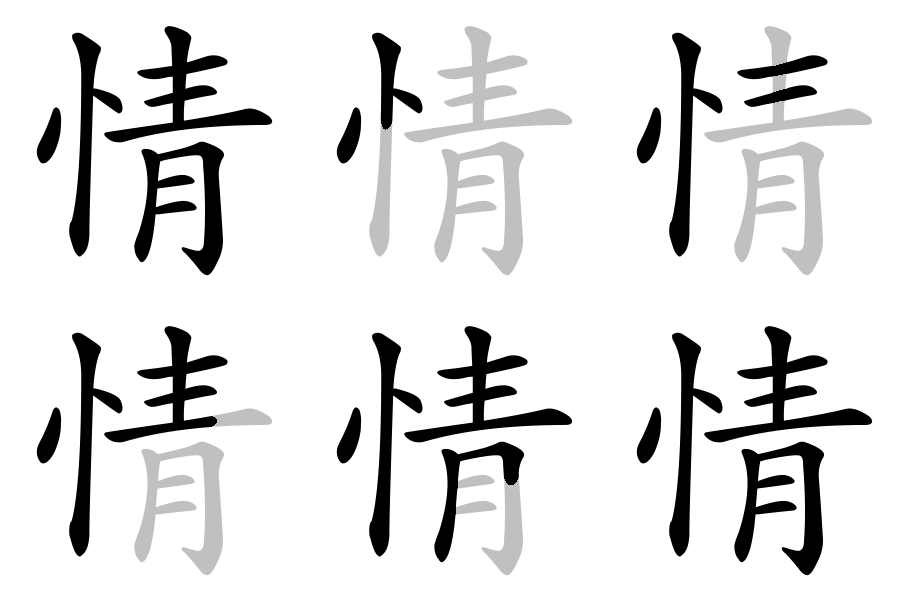
情
- feeling;
- emotion;
- sentiment;
Etymology
A phono-semantic compound consisting of:
心 (“heart; mind”) — semantic component, indicates mental states, emotions, and inner experience.
青 (“clear; pure; fresh”) — phonetic component, supplies the sound "jeong" and contributes a nuance of clarity or vividness.
Originally, 情 referred to the true inner state of the heart, especially emotions as they arise naturally, before being shaped or restrained by reason or social norms.
Semantic development:
The meanings of 情 developed along several closely connected lines:
- inner feelings / emotions — natural human emotions and sentiments
- true intention or disposition — what one genuinely feels or means
- circumstances / situation — the emotional or factual condition surrounding an event
This evolution reflects a classical worldview in which emotion, intention, and circumstance are inseparable aspects of reality.
Usage in Korean
In Korean, 정 is a culturally central concept, often describing deep emotional bonds, warmth, and long-term attachment beyond simple emotion.
Emotion & sentiment:
감정 (感情) — emotion; feeling
정서 (情緖) — emotional state; sentiment
애정 (愛情) — affection; love
정의 (情誼) – affection, bond
동정 (同情) – sympathy
Human relations:
인정 (人情) — human feeling; compassion
정리 (情理) — emotion and reason
정분 (情分) — personal affection or bond
Situation / circumstances:
사정 (事情) — circumstances; situation
실정 (實情) — the real situation
형편 (情況) — condition; state of affairs
情 is an extremely familiar hanja in Korea — even appearing on the packaging of Orion Choco Pie (초코파이 情), where it conveys warmth, affection, and caring emotion.
Additional notes
情 represents raw, lived human feeling, often contrasted with 理 (reason; principle). It bridges inner emotion and external reality, making it semantically broad and context-sensitive.
Because of its abstract nature, it appears frequently in philosophy, psychology, law, and literature.
In Confucian philosophy, emotions (情) are natural, but must be guided by ritual and reason.
情 is morally neutral by itself; its value depends on balance and context.
Related characters:
心 — heart; mind
意 — intention; thought
感 — to feel; to be affected
理 — reason; principle
愛 — love
Among these, 情 emphasizes authentic inner feeling as it exists within real-life circumstances.
Classical citations:
《禮記》 (The Book of Rites)
「情深而文明」
“When feeling is deep, refinement follows.”
《孟子》 (Mencius)
「人之情也」
“This is human nature and feeling.”
Buddhist texts
「情愛是苦之本」
“Emotional attachment is the root of suffering.”
Alternative forms
In mainland China, Hong Kong (based on its educational standard), Japanese kanji and Vietnamese Hán Nôm, the bottom right component is written ⺝ with a vertical 丨 left stroke.
In Taiwan, the bottom right component is written 月 with a curved 丿 left stroke.
In Korean hanja, the bottom right component is written 円 which is the historical form found in the Kangxi Dictionary.
- 心手一月 (PQMB)
- ⿰ 忄 青 (G H T J V)
- ⿰ 忄 靑 (K)