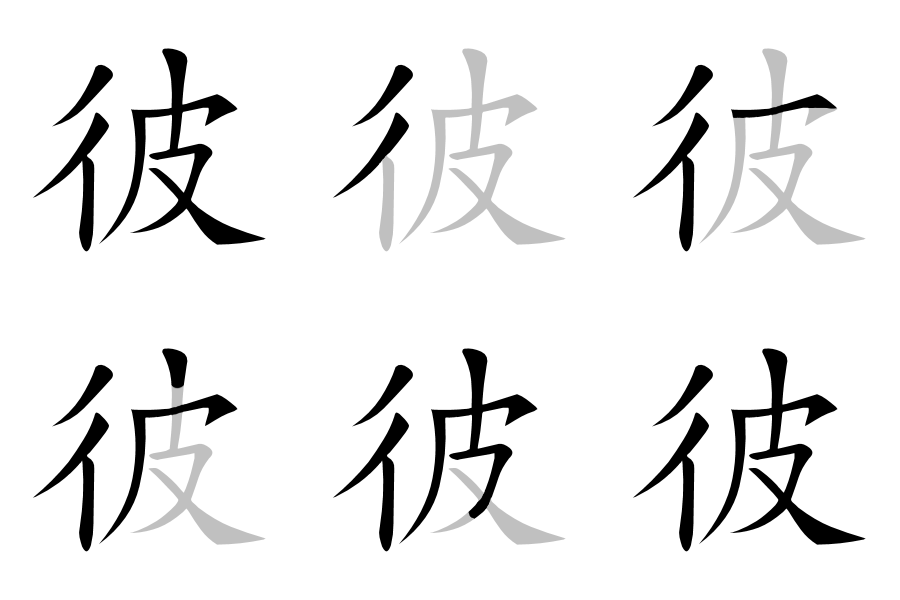
彼
- that;
- he;
- she;
- it;
In Classical Chinese, 彼 commonly means “that” or “the other,” often in contrast with 此 (“this”). It may refer to a person, object, or abstract concept.
Etymology
A phono-semantic compound consisting of:
彳 (step; to walk) — semantic component;
皮 — phonetic component, supplying the sound 피 (bǐ / pi).
The presence of 彳 (“to step,” “to walk”) is somewhat obscure in meaning.
In the Shuōwén Jiězì (說文解字), it is explained as:
「往,有所加也。」
“To go — to proceed further.”
This suggests that 彼 may originally have conveyed the idea of “going further” or “that which lies beyond,” which naturally developed into the demonstrative meaning “that (over there).”
Over time, its primary function became grammatical rather than lexical.
Usage in Korean
In Korean Hanja education, it is mainly encountered in idioms and classical reading.
피차 (彼此) — each other; mutually
피안 (彼岸) — the other shore (Buddhist term for nirvana)
후차박피 (厚此薄彼) — to favor one over another
Additional notes
彼 differs from related demonstratives:
此 — this (near speaker)
其 — his; its; that (possessive or neutral demonstrative)
他 — other; he (later pronoun usage)
In Classical Chinese, 彼 and 此 form a fundamental contrast pair (that vs this).
此一時,彼一時
“This is one time; that is another.”
Unlike 他, which became the standard third-person pronoun in later vernacular Chinese, 彼 is more literary.
Classical citations:
《論語》 (The Analects)
「彼一時,此一時也。」
“That was one time; this is another.”
《詩經》 (The Book of Songs)
「彼黍離離」
“There the millet grows luxuriantly.”
《莊子》 (Zhuangzi)
「彼亦一是非,此亦一是非。」
“That too is a ‘right and wrong’; this too is a ‘right and wrong.’”
These examples illustrate its role as a contrastive demonstrative in philosophical and poetic discourse.
Words that derived from 彼
Neighboring characters in the dictionary
