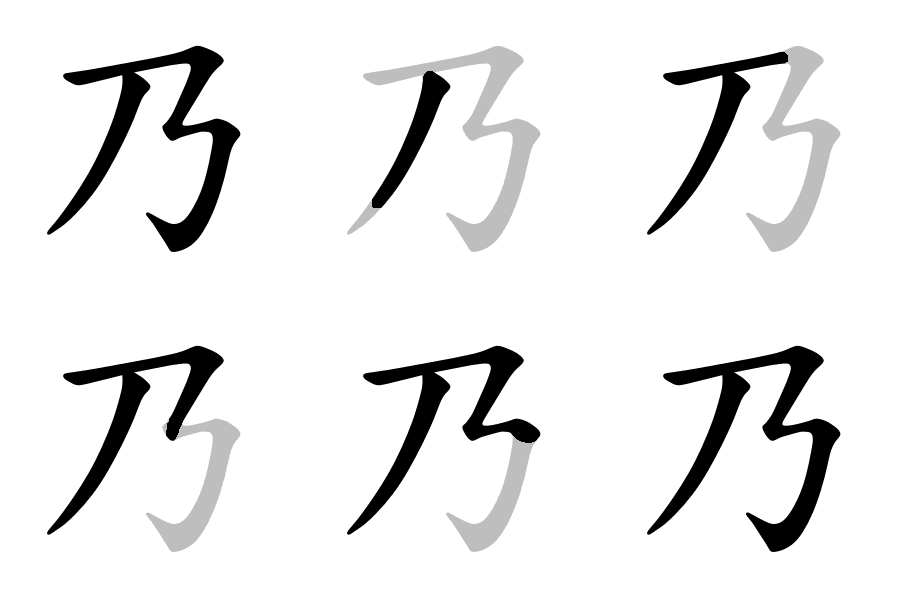
乃
- thus;
- then;
- only;
- surprisingly;
Etymology
Traditionally explained as a pictograph.
In oracle bone & bronze inscriptions depicted a woman’s breasts (a symbol of fertility and nurturing).
Originally, 乃 was the original form of 奶 (내, “milk, breast”).
As its use shifted into a grammatical particle, 女 (woman radical) was later added to create 奶, leaving 乃 for functional/grammatical use.
From this concrete image developed abstract grammatical uses indicating sequence, result, emphasis, or contrast. Over time, 乃 became a function word (adverb/conjunction) rather than a concrete noun.
Some alternative theories:
- depicts twisted rope (suggesting connection).
- represents the motion of swinging something.
Semantic functions:
- sequential result — “then; thereupon”
- delayed realization — “only then; not until”
- emphatic assertion — “indeed; actually”
- contrast / reversal — “on the contrary; unexpectedly”
Usage in Korean
The hanja 乃 is a classical particle with nuanced meanings, often depending on context:
- “thus, so” (이에);
- “then, only then” (비로소);
- “but, rather, on the contrary” (도리어);
- “unexpectedly, surprisingly” (뜻밖에);
- “moreover, also, just” (더구나, 또, 다만).
Additional notes
Words that derived from 乃