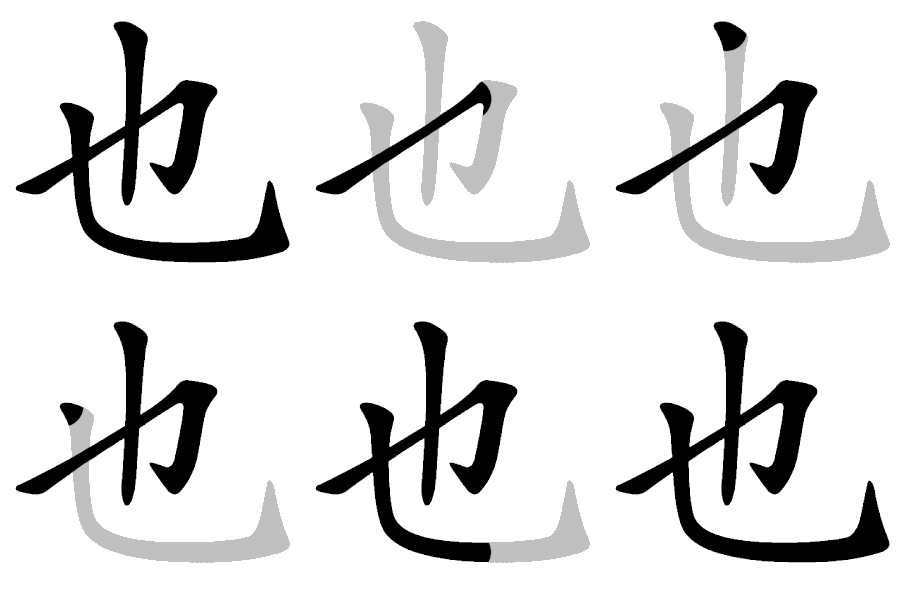
也
- also, too, as well (Modern Mandarin);
- final particle (Classical Chinese);
Etymology
The original graph is obscure. Competing theories:
- Female genital shape (說文解字), based on small-seal script (小篆).
- Snake shape (later paleographic hypothesis).
- Spout or jug shape (bronze forms).
In Western paleography the consensus is:
Original semantic value uncertain; early loan for particle function.
By the Warring States period it functioned purely as a grammatical particle, losing its original pictorial meaning.
Usage in Korean
Used only in classical quotations, Buddhist texts, or Chinese grammar instruction.
Meaning:
- sentence-final classical particle
- emphatic or declarative marker
Examples:
~也 — “indeed ~”, “~이다”
非也 (비야) — “It is not so.”
然也 (연야) — “So it is.”
亦可也 (역가야) — “It is also permissible.”
Additional notes
The last character of the Thousand Character Classic (千字文). The text ends with:
「信而好古,參乎古也。」
“Trust and delight in antiquity, be joined with the ancient ones also.”
Often confused with “~이다”
In Korean education, 也 = ‘이다’ is taught, but this is only one of several classical values.
Other functions: contrast, assertion, rhetorical force, or exclamation.
Not related to the plant “이끼.”
The Korean gloss 이끼 is purely phonetic and refers to 입겻, a grammatical marker.
Classical citations:
《論語·學而》 (The Analects)
「有朋自遠方來,不亦樂乎?」
“…is it not indeed joyful?”
Here 也 is omitted in later tradition but appears in early manuscripts. It functions as an assertive particle: “indeed / truly”.
《孟子·梁惠王上》 (Mencius)
「王亦曰仁義而已矣,何必曰利也?」
“The King also speaks of benevolence and righteousness—why must he speak of profit as well?”
也 = final particle marking rhetorical question.
《史記·項羽本紀》 (Records of the Grand Historian)
「縱江東父兄怜而王我,我何面目見之也!」
“Even if the elders of Jiangdong pitied me and made me king, how would I have the face to see them!?”
也 = emotional exclamation, reinforcing indignation.
《詩經·邶風·式微》 (Book of Odes)
「式微式微,胡不歸也!」
“It grows dark, grows dark—why do you not return!?”
也 = emphatic ending.
Words that derived from 也