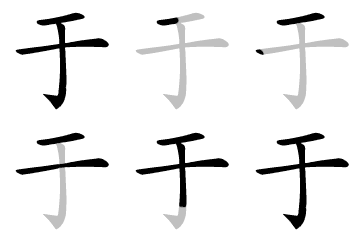
于
- at, in, to, from, than;
Etymology
Originally pictographic / loan character.
In oracle bone script, 于 originally represented "possibly a bent object or tool."
Some scholars connect it to movement or extension. However, its original concrete meaning was lost, and it became widely used as a phonetic loan for grammatical functions.
By the Zhou dynasty, 于 was used mainly as "a preposition-like particle."
Usage in Korean
Used mainly in literary Sino-Korean compounds:
급우 (及友) — classmate (older usage)
우연 (偶然) — coincidence (not same 于 but same pronunciation)
Additional notes
于 is one of the foundational particles of Classical Chinese grammar.
It functions similarly to English “in / at / to / from / than.”
Because Classical Chinese is highly compact, 于 carried multiple relational meanings.
Unlike semantic characters, 于:
- does not represent a concrete object
- represents grammatical relationship
It is a structural character — essential for understanding classical texts.
It functions similarly to the character 於, serving as a preposition or particle in classical Chinese.
In usage, 于 and 於 are often interchangeable, both expressing relations such as "in," "at," "to," "from," or "than", depending on context.
Though it has other historical uses, 于 is now mainly seen in literary or formal language, especially in classical texts or set phrases.
Examples:
生于忧患 — “Born in hardship”
于心不忍 — “Cannot bear it in one’s heart”
终于成功 — “Finally succeed”
Words that derived from 于
- 一木 (MD)
- ⿱ 一 𬺰
- ⿻ 二 亅
- ⿻ 丁 一