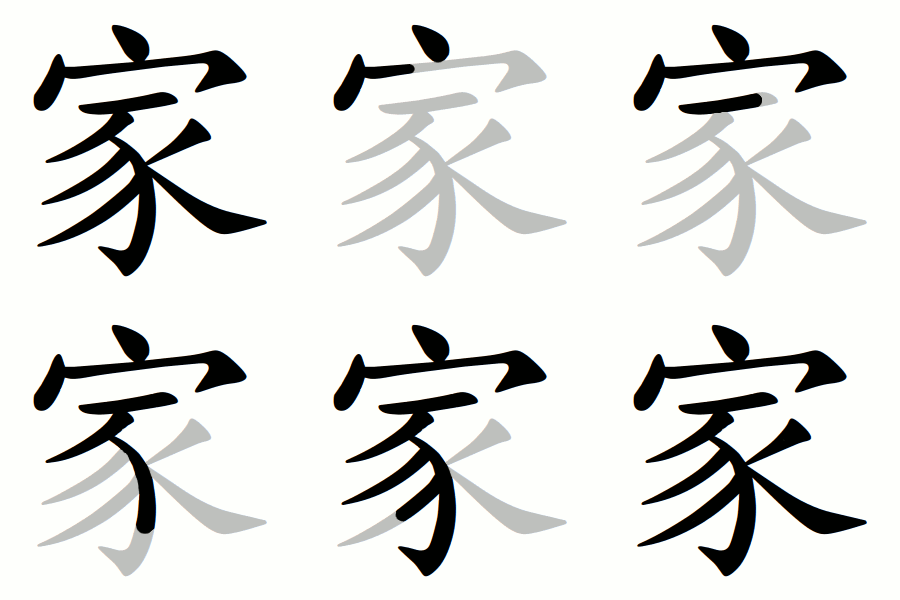
家
- home;
- family;
- household;
Etymology
A compound ideograph.
Traditional interpretation:
宀 (house roof) gives the meaning
豭 (가) — the “boar” (later simplified as 豕) — gives the sound.
But no early inscriptions with 宀 + 豭 have been found.
Linguistic reconstruction:
Scholars believe 家 combines 宀 (roof) and 豕 (pig).
Some even suggest the earlier form 하 (⿳彑儿乂), a variant of pig with explicit genital marking, was used under 宀.
A pig kept under a roof, symbolizing a settled household with livestock, which in early agrarian society signified a home and family unit. From this concrete image arose the broader meanings of household, family, and later social groups or professional schools.
A form in oracle bone script already shows 宀 + 豕 rather than 宀 + 하. Over time, 豕 became the fixed lower component.
Popular folk etymology:
Ancient Chinese supposedly kept pigs under their houses to ward off snakes, therefore “house with pigs” = home.
Semantic development:
- dwelling — a physical home
- household — family unit
- lineage/group — clan; school of thought
- professional identity — expert; practitioner
Usage in Korean
家 is one of the most productive characters in East Asian vocabularies, spanning daily life, social organization, and academia.
Common compounds:
가족 (家族) — family
가정 (家庭) — household; home; family
가구 (家口) - household
가장 (家長) - head of household
국가 (國家) — state; nation
문가 / 문벌 (門家 / 家門) — lineage; clan
작가 (作家) — writer
화가 (畫家) — painter
전문가 (專門家) — specialist; expert
Suffixal use (profession/school):
유가 (儒家) — Confucian school
도가 (道家) — Daoist school
Additional notes
Words that derived from 家