隹
- tailed bird;
Etymology
According to the Shuowen Jiezi dictionary, it is a pictograph representing a short-tailed bird viewed from the side. However, ancient script forms (oracle bone to bronze inscriptions) do not clearly confirm that it referred only to short-tailed birds.
In the early 20th century, renowned Chinese epigrapher Luo Zhenyu (羅振玉) claimed, based on oracle bone rubbings, that 隹 and 鳥 were often used interchangeably, and were in fact the same character. Most modern scholars agree with this theory, though some still argue that 隹 refers to birds in general, while 鳥 is a pictograph of a specific bird species.
隹 is also the original character of 唯 ("only, merely"), and in this context, it carried the meaning "to be" (similar to modern Mandarin A是B).
In many characters that appear to use 隹 as a phonetic component, it is actually 唯 acting as the phonetic part.
Usage in Korean
When used as a radical, 隹 typically indicates that the character relates to birds.
Examples where it is part of the phonetic component:
推 ("to push")
誰 ("who")
Examples where it is the semantic radical:
離 ("to separate")
雀 ("sparrow")
雙 ("pair")
難 ("difficult")
隼 ("hawk")
雜 ("mixed")
集 ("to gather")
雄 ("male animal")
According to the Liùshū Xún Yuán (六書尋源), since 隹 depicts a short-tailed bird, it emphasizes the head. This explains its use in characters like 進 ("to advance") and 推 ("to push"), which metaphorically relate to leading or moving forward.
Similar shape characters
隹 is easily confused with:
佳 ("beautiful"): formed from 亻 (person radical) and 圭, which itself is two 土 (earth) components stacked. Its horizontal strokes alternate slightly in length, and the stroke order is 亻 → 土 → 土.
住 ("to reside"): composed of 亻 and 主 (lord), with stroke order 亻 → 主.
In contrast:
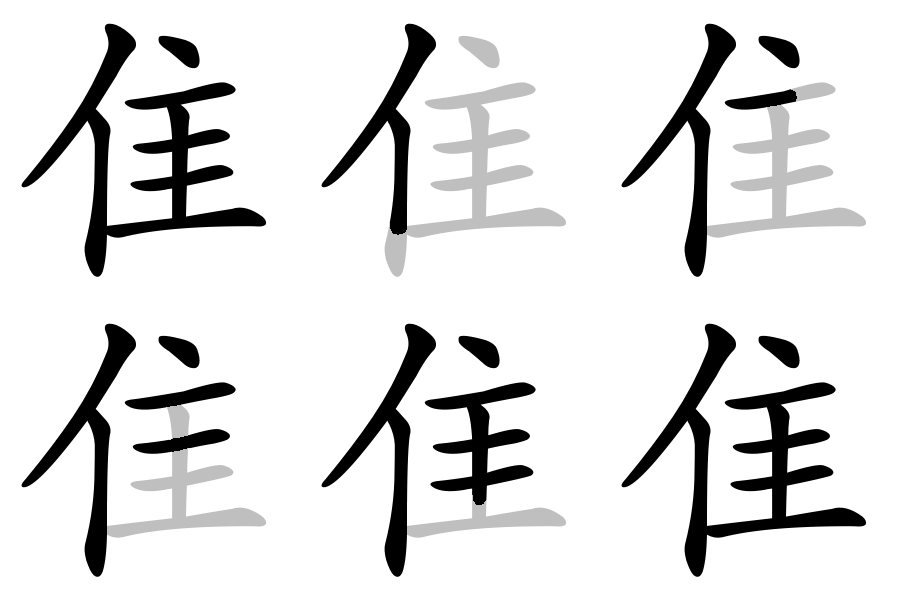
隹 has a compressed shape that attaches tightly to the 亻 radical when used on the right side of a character.
Its horizontal strokes (4 total) are arranged with the top and bottom lines slightly longer than the middle two.
The stroke order is 亻 → 丿 → 三 → 丨 → 一.
佳 is under the 人 radical (6 strokes), while 隹 is a radical by itself.
Characters with 隹
- 人土 (OG)
- 難人土 (XOG)
- ⿰ 亻 ⿱ 亠 龶 (G H T)
- ⿰ 亻 ⿻ 主 一 (G H T)
- ⿰ 亻 ⿳ 丿 一 龶 (J K)
Neighboring radicals in the dictionary
