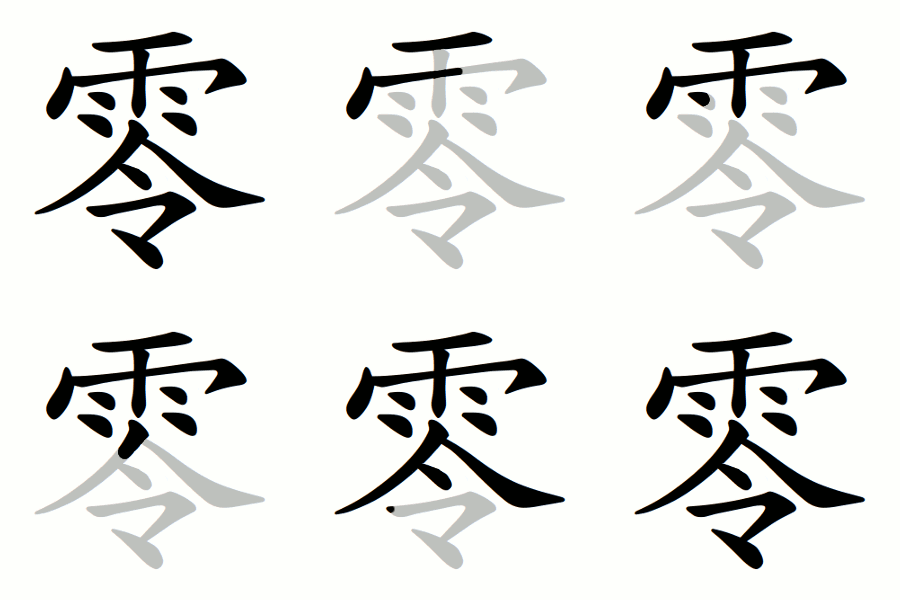
零
- zero;
- to fall, to rain;
Etymology
A phono-semantic compound composed of:
雨 (rain) — semantic component meaning, indicates falling droplets, leading to the original sense of scattered drops of rain;
令 — phonetic component providing the sound (령 / líng).
Semantic development:
- falling drops of rain;
- scattered small pieces;
- remainder or fragment;
- the number zero.
Thus the concept evolved from scattered droplets to the idea of nothing or zero.
Usage in Korean
영 (零) — zero
영도 (零度) — zero degrees
영점 (零點) — zero point
영세 (零細) — very small-scale
Additional notes
零 emphasizes small scattered parts or the absence represented by zero.
Related characters:
雨 — rain
空 — empty, zero
〇 — numeric symbol for zero
無 — nothing; none
In modern Chinese, 零 is the standard written form of the number zero in reading numbers.
The first known use of 零 to represent the concept of zero was by the Chinese mathematician Li Ye (李冶) in the year 1248.
Just as numbers like 1, 2, and 3 are written in Chinese as 一, 二, 三, the number 0 is written as 零 in Chinese. However, because 零 has many strokes, it is often simplified to the round symbol 〇 when writing numbers.
In some cases—such as for preventing forgery — 零 is used instead of 〇, and in such usage, it is considered a variant form of 〇. Thus, 零 is essentially a variant character for the number 0.
Another character, 空, also carries the meaning of "zero" or "empty" in Chinese, and since it has fewer strokes than 零, it is sometimes used in place of 零.
Alternative forms
㩕 㬡 㯪 澪 燯 鿅 䌢 䙥 䴫 䴇 蕶
𠏡 𠟨 𨞖 𪞮 𨗺 𤖜 𤾨 𥋞 𥖟 𥢴 𥼸 𦪩 𨆖 𨣖 𨭭 𩁎 𩟃 𩪥 𪋪
𮋔 𮘿
- 一月人戈戈 (MBOII)
- ⿱ ⻗ 令