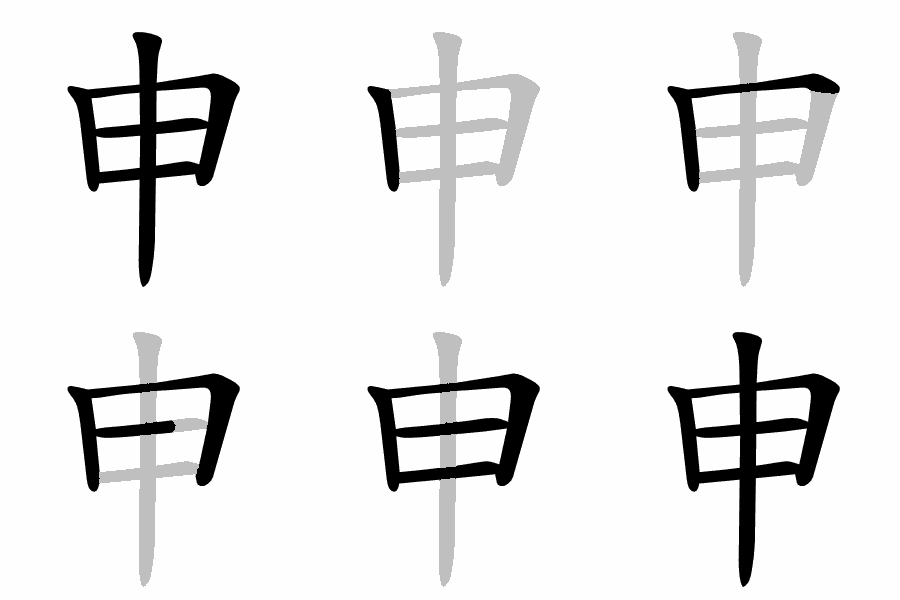
申
- to state, report, announce;
- to extend, stretch;
Etymology
申 in oracle bone and bronze inscriptions shows a bolt of lightning descending from the sky.
Thus 申 originally meant “lightning, flash from heaven.”
Later, to distinguish “lightning” clearly, the 雨 radical was added to form 電 “lightning, electricity”.
Semantic extension: “to extend, stretch.”
The pictograph’s vertical shape gave rise to the sense of “to extend downward / stretch out.” To specify this meaning, 人 was added 伸 “to stretch, extend”.
Meaning “to report, announce”:
By semantic extension from “to extend outward one’s words,” 申 came to mean “to state, to report, to submit.”
This meaning survives strongly in:
Korean: 신고(申告) (to report)
Japanese: 申す(もうす) (to say, to report)
Chinese: 申報 / 申請 (to declare; to apply)
Meaning “repeat, reiterate”:
Because 申 visually looks like something being repeated or extended, it gained “to reiterate, to say repeatedly.”
Seen in expressions:
三令五申 — “order three times, instruct five times” (repeated admonition)
申申當付 — “urge repeatedly”
申 as a cyclical sign (十二支):
申 is the 9th Earthly Branch, corresponding to:
- the Monkey in the zodiac
- direction: south-west by west (WSW)
- season: late summer (7th lunar month)
- element relation: Metal (庚金)
It is the source of old Korean words like 잔나비 (monkey).
Usage in Korean
신고 (申告) — to report, declare
신청 (申請) — to apply
진신당부 (申申當付) — to urge repeatedly
삼령오신 (三令五申) — to admonish again and again
신명기 (申命記) — Book of Deuteronomy (“repeated commandments”)
Zodiac / calendrical usage:
신년 (申年) — Year of the Monkey
신월 (申月) — 7th lunar month (≈ August)
신시 (申時) — 3–5 PM
신군 (申君) — a person born in the year of 申 (traditional usage)
Additional notes
Correspondence to Twelve Earthly Branches (十二支): 申
Animal: Monkey
Direction: WSW (240°)
Season: Late summer
Color: white / silver / grey
Five elements association: Metal (庚金)
Hidden stems (地藏干):
戊土 (7/4–7/10 lunar)
壬水 (7/11–7/17 lunar)
庚金 (7/18–8/4 lunar)
Combined stem-branch (干支):
甲申 — 泉中水 “water of the deep spring”
丙申 — 山下火 “fire under the mountain”
戊申 — 大驛土 “earth of great roads; transition”
庚申 — 石榴木 “pomegranate wood; ripening/fruiting”
壬申 — 劍鋒金 “sword-edge metal; sharpness”
Classical citations:
《書經·君牙》 (Book of Documents)
「予其惟三事之申。」
“I shall reiterate these three matters once more.”
《論語·述而》 (Analects)
「子曰:‘默而識之,學而不厭,誨人不倦,何有於我哉?’ 申之曰……」
“The Master said… (and repeated it).”
申 here = “to repeat / restate”
《左傳·昭公二十五年》 (Zuo Commentary)
「王使申之。」
“The king sent him to report it.”
《漢書·郊祀志》 (Book of Han)
「申命於天下。」
“He proclaimed the command to all under heaven.”