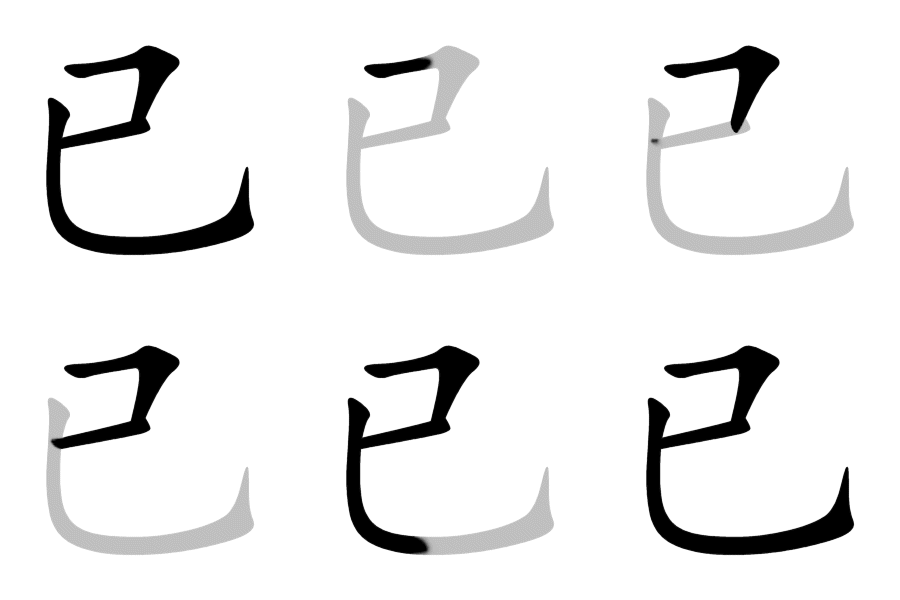
已
- already;
- to stop;
- to cease;
- to finish;
Etymology
A pictographic character.
In oracle bone and bronze inscriptions, it depicts a curled fetus or a bent body, symbolizing a state of completion or termination.
From this original image came the core meaning “to stop; to cease; to come to an end”
Only later did the meaning extend to the abstract temporal sense “already”, indicating that an action or state has reached completion.
Thus, the modern adverbial meaning “already” is derived, not original.
Usage in Korean
已然 (이연) — already so; inevitable (literary)
已往 (이왕) — already past; bygone
已畢 (이필) — already finished; completed
已定 (이정) — already decided
已矣 (이의) — that is all; it is finished (classical ending)
Additional notes
Grammatical and functional usage:
Verb (classical) - to stop, to cease, e.g. 死而後已 (cease only after death)
Adverb - already, e.g. 已成 (already completed)
Sentence-final particle (classical) - expressing conclusion, resignation, or emphasis, similar to “that is all” or “enough”
Although 已 is commonly glossed as “already” in modern dictionaries, its semantic core is cessation, not time.
In classical texts, 已 often carries a philosophical or emotional nuance, such as resignation, finality, or moral resolve.
Unlike modern Chinese, classical usage frequently places 已 at the end of sentences for rhetorical effect.
In Korean education, 已 is often taught together with 己 / 巳 for contrast.
Classical citations:
《論語》 (The Analects)
「學而不思則罔,思而不學則殆,已矣。」
"Learning without thought leads to confusion; thought without learning leads to danger. That is all."
《論語》 (The Analects)
"Only after death does it cease."
《老子》 (Lao Tzu)
「功成身已退。」
"When the work is accomplished, one withdraws."
In classical Chinese, 已 frequently marks finality, completion, or cessation, often stronger than its modern “already” sense.
Similar shape characters
已 — to stop; already
己 — self; oneself
巳 — the sixth Earthly Branch
These three characters are graphically similar but semantically distinct and are a common source of confusion.
Words that derived from 已
Neighboring characters in the dictionary
