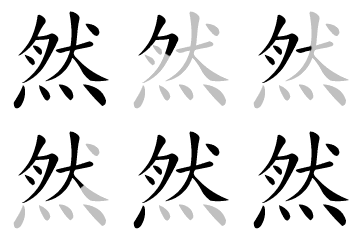
然
- so;
- thus;
- in that way;
Etymology
Original form is a combination of:
肉 (육, “meat”),
犬 (견, “dog”),
火 (화, “fire”).
Traditionally interpreted as an ideogrammic compound representing the burning of dog meat, which led to the meaning “to burn” or “to roast.”
This interpretation is mentioned in Shuowen Jiezi (説文解字 shuōwén jiězì).
Later, the character was loaned for the abstract meaning “so,” “thus,” “in that way.”
To preserve the original “burning” meaning, 火 was added to create a new character: 燃 (연, “to burn, blaze”).
Some scholars oppose the “dog meat” explanation, saying the character depicts the inevitability of smoke when meat is burned — a broader symbolic meaning.
Another theory suggests 然 might actually be a phono-semantic compound:
肰 may have been pronounced /njen/ in Old Chinese.
It could have been borrowed to represent a related Proto-Sino-Tibetan root /nan/ meaning “light/fire,” with 火 supplying the “burning” sense.
Modern research shows that many characters once thought to be ideograms are really phono-semantic compounds, so the traditional “dog meat burning” interpretation might be folk etymology rather than strict historical fact.
Usage in Korean
자연 (自然) — nature; natural state
당연 (當然) — naturally; of course
우연 (偶然) — coincidence; by chance
필연 (必然) — inevitability
연후 (然後) — after that; only then
Today, 然 mainly means “so, thus” and appears in countless compounds across Korean, Chinese, and Japanese.
Additional notes
In Classical Chinese 然 is extremely important as a function word:
1. Sentence affirmation
“It is so.”
2. Logical transition
然則 — if so, then…
3. Adverbial marker
表示 상태·방식 (indicating manner or condition)
4. Negative construction
不然 — if not so; otherwise
Related characters:
如 — like; as (comparison)
是 — right; correct (affirmation)
化 — change (transformation)
成 — become (result)
然 does not describe what happens, but confirms that something is the case.
It is central to philosophical argumentation in Confucian, Daoist, and Legalist texts.
In Korean, its meaning survives almost entirely through Sino-Korean compounds.
Many abstract nouns ending in -연 (然) indicate state, condition, or inevitability.
The Korean expression 긴가민가하다 (“unsure, doubtful”) comes from the older phrase 其然인가 未然인가 (“is it so, or not so?”), which eventually shortened to 긴가민가.
Alternative forms
Alternate forms: 𦛡 = 然 = 𦛦 = 肰.
肰 alone once meant “dog meat.”
In modern Chinese, this sense is largely obsolete and replaced by words like 狗肉 (“dog meat”) or (esp. in Cantonese) 香肉 (“fragrant meat”).
- 月大火 (BKF)
- ⿱⿰ 𱼀 犬 灬