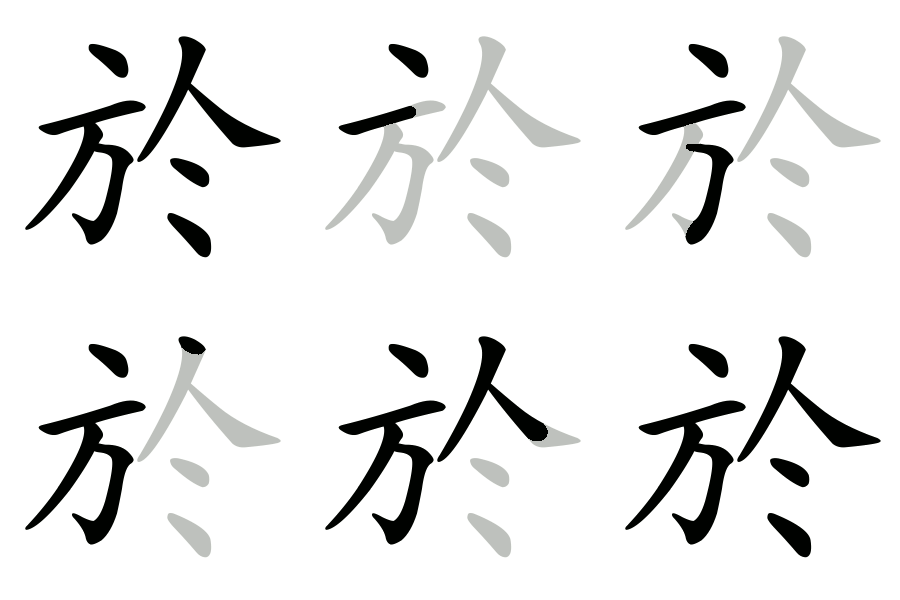
於
- at;
- in;
- to;
- from;
- than;
- exclamatory particle;
Etymology
Although traditionally classified under the 方 radical, this is purely graphic, not semantic.
於 originated as a variant form of 烏 (crow). It was created in the late Western Zhou period. The character originally depicted a crow, similar to 烏.
In early usage, 烏 functioned both as:
- a noun (“crow”)
- an exclamatory particle (“ah!”, “alas!”)
- a grammatical particle
Over time, the system was regularized:
烏 → fixed as the noun “crow”
於 → fixed as a grammatical particle
嗚 (烏 + 口) → inherited the exclamatory function
Thus, 於 lost all lexical meaning and became a pure function word.
Relationship with 于:
于 existed earlier (attested already in oracle bone inscriptions). Originally distinct in pronunciation and usage. After 於 emerged, their functions gradually merged.
By the late Spring and Autumn → Warring States period 于 and 於 were functionally interchangeable. 於 became dominant in usage.
Additional notes
Related forms:
于 — historically distinct, later merged in function
嗚 — inherited the exclamatory function
烏 — original pictograph (“crow”)
Script and graphic notes:
Early forms resembled 鳥-like crow shapes.
Unlike other 方-radical characters derived from 㫃, 於 is not related to flags.
Right-side 人 component:
Standard form: 人
Hong Kong standard: 𠂉
Final stroke direction varies by font:
Unicode reference: ↘
Some fonts / Korean court standard: ↗
Alternative forms
扵 (U+6275) — vulgar/graphical variant
Words that derived from 於
- 卜尸人卜 (YSOY)
- ⿰ 方 仒 (G T J K V)
- ⿸ 𭤨 ⺀ (H)