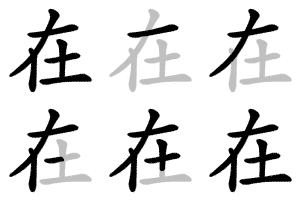
在
- to be, to exist;
- to be present;
Etymology
Formed as a phono-semantic compound:
土 (earth, soil) provides the semantic element, indicating presence in a place.
才 (talent, ability) provides the phonetic component.
Original sense: “to be situated in the earth/at a place”, later extended to general existence and presence.
Semantic range:
- to exist, to be present (존재하다, 있다);
- to be located at/in (소재하다);
- to attend, be present (출석하다);
Usage in Korean
존재 (存在) — existence, to exist
부재 (不在) — absence, nonexistence
소재지 (所在地) — location, address
현재 (現在) — the present, “now”
재학 (在學) — to be enrolled in school
재직 (在職) — to hold office, be in position
Additional notes
存 (존) also means “to exist,” but emphasizes continuity, preservation, or keeping (e.g. 보존 “to preserve”). 存 implies existence in terms of lineage, succession, or legacy.
在 (재) emphasizes physical presence or location — being “at” or “in” a certain place or time.
有 (유) overlaps in meaning (“to exist”), but primarily denotes possession or ownership (“to have”).
Historical/linguistic note:
In Middle Korean, 在 was glossed as 겨다, which survives only in the honorific form 계시다 (“to be present”).
In modern Mandarin, 在 is used as a progressive aspect marker (e.g. 我在吃飯 — “I am eating”).
In Japanese, 在 is read as ある (“to be, to exist”) in certain contexts, often for physical placement or presence.
- 大中土 (KLG)
- ⿸ 𠂇 ⿰ 丨 土