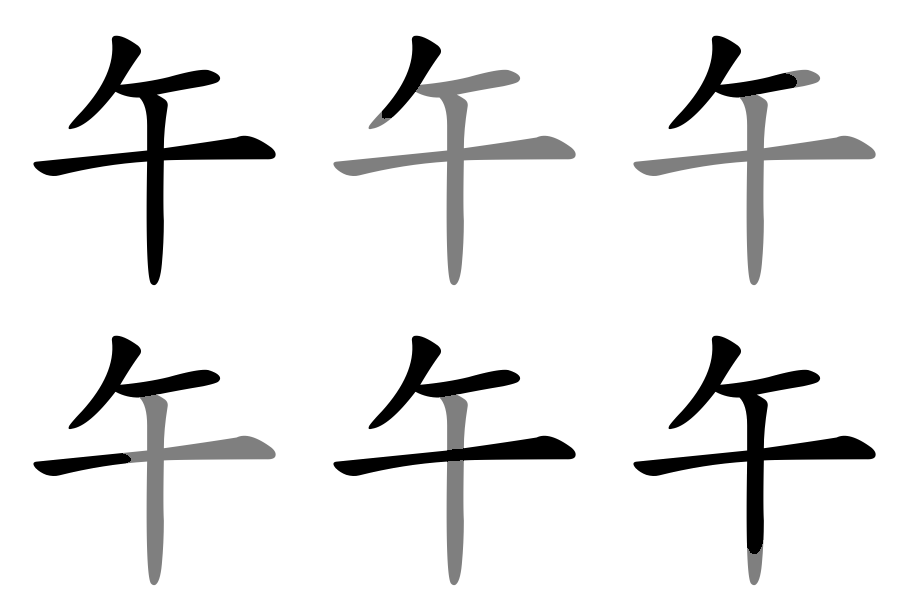
午
- noon;
- midday;
- the 7th Earthly Branch (地支);
Etymology
A pictograph.
In oracle bone script, 午 depicted the shape of a vertically standing mortar pestle (절굿공이).
Original meaning "wooden pestle used for pounding grain."
Later, the character was borrowed phonetically to represent the seventh Earthly Branch (地支).
Because that calendrical meaning became dominant, a new character 杵 was created to preserve the original meaning “pestle.”
Thus:
午 → calendrical branch
杵 → pestle (restored semantic clarity)
This is a classic example of semantic borrowing and differentiation.
Semantic development:
- pestle (original pictograph)
- Earthly Branch name
- Zodiac sign (Horse)
- noon / midday
- associated cosmological symbolism
Thus, 午 evolved from:
agricultural tool → calendrical marker → time of day → zodiac identity.
Usage in Korean
Time:
오시 (午時) — 11 AM–1 PM
정오 (正午) — exactly noon
Zodiac:
오년 (午年) — Year of the Horse
오군 (午君) — person born in a Horse year
Month:
오월 (午月) — 5th lunar month
(roughly corresponds to June in solar calendar)
Additional notes
Calendrical significance (Earthly Branch):
午 is:
- the 7th of the 12 Earthly Branches (十二地支);
- associated with the Horse (말) in the zodiac;
- corresponds to the time period:
午時 (오시): 11:00 AM – 1:00 PM
From this time association, the meaning “midday” developed.
Cosmological correspondence:
Within Five-Element (五行) and traditional cosmology:
Element: Fire (火)
Yin–Yang: Yang Fire (丁火 association)
Symbolic images:
- horse
- small flame
- candlelight
- beacon
- sun at zenith
Color associations:
- red
- pink
Hidden Heavenly Stems (地藏干)
Within 午 are said to be contained:
丙火
己土
丁火
Traditional allocation periods (lunisolar system interpretations):
4/29 – 5/9 (lunar): 丙火
5/10 – 5/20 (lunar): 己土
5/21 – 6/1 (lunar): 丁火
These belong to traditional metaphysical systems and are not linguistic features.
Related characters:
杵 — pestle (original object meaning)
牛 — ox (visually similar)
晝 — daytime
馬 — horse (zodiac animal)
火 — fire (elemental association)
Classical usage:
《周易 · 繫辭下傳》 (Appended Statements, Part II)
「日中為市,致天下之民,聚天下之貨,交易而退,各得其所。」
“At midday they formed a market,
bringing together the people of the world,
gathering together the goods of the world.
They exchanged and then dispersed,
each obtaining what was proper to them.”
Refers to midday market gathering.
正午陽盛 — “At true noon, yang energy is strongest.”
Words that derived from 午
- 人十 (OJ)
- 難人十 (XOJ)
- ⿱ 𠂉 十
- ⿰ 丿 干