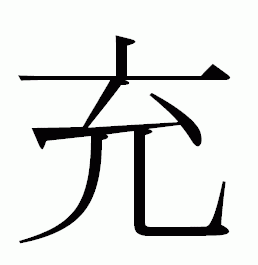
充
- to fill, to supply;
Etymology
Considered a pictographic or pictophonetic-evolving character.
Early bronze inscriptions show:
A human figure with an expanded belly — expressing “fullness” or “being filled.”
Later, in clerical/regular script, it became abstracted into the current form.
Some paleographers interpret the original shape as a child wrapped in clothing, expanding outward — a metaphor for “filling out.”
Usage in Korean
충분 (充分) — sufficient, enough
충전 (充電) — to recharge, to load electricity
충실 (充實) — solid, substantial
충만 (充滿) — full, overflowing
충직 (充直) — loyal, upright (older term)
충임 (充任) — to fill a post / to serve as
These preserve the core sense: to fill, to supply, to make complete.
Additional notes
充 sometimes means “to serve as / to act as”:
充御 — to serve in the palace
This reflects “to fill a position.”
In some classical contexts, it can function like a strengthening prefix:
充國 — the entire nation
充耳 — completely (covering the ears)
Classical citations:
《論語·里仁》(Analects 4:5)
「 君子欲訥於言而敏於行。信近於義,言可復也。恭近於禮,遠恥辱也。充而不溢。」
“The noble person is slow of speech but quick in action… He is full (充) yet never overflows.”
充 here means “full, sufficient, but not excessive.”
《孟子·梁惠王上》(Mencius)
「 以五十步笑百步,則何如?曰:不可,充類也。」
“Is it acceptable for one who flees fifty paces to laugh at one who flees a hundred?” Mencius replied: “No, for they are of the same kind (充類).”
充類 means “belonging to the same category / essentially equivalent,” from the sense of “fully matching”.
《詩經·小雅·節南山》(Book of Odes)
「 彼君子兮,不素食兮。施于中谷,充滿其室。」
“That noble man does not eat idly. He labors in the central valley, and his house is filled with abundance.”
充 = “filled (with blessings/harvest).”
Derived characters
- 卜戈竹山 (YIHU)
- ⿱ 𠫓 儿
Neighboring characters in the dictionary
