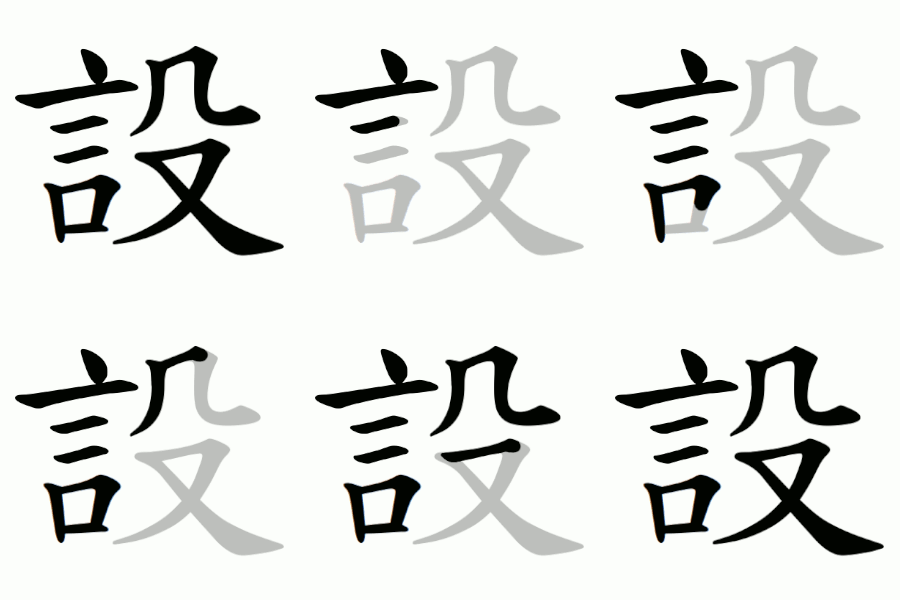
設
- to establish;
- to set up;
- to found;
Etymology
A phono-semantic compound composed of:
言 (speech, words) — semantic element, indicates actions carried out through declaration, instruction, or formal statement;
殳 (halberd, striking weapon) — phonetic element, providing the sound “설” and possibly implying “action” or “setting up” something.
Together, 設 expresses bringing something into existence through intentional action, often by formal decision or proclamation.
Original meaning: “to put in place,” “to plant,” “to set down.”
Shares roots with 藝 (예) via the older form 埶, which originally meant “to plant, to cultivate.”
Over time, 設 took over the sense of “to set up or establish,” while 藝 shifted toward meanings of “skill” or “art.”
The meanings of 設 developed along a clear institutional trajectory:
- to arrange or put in place — setting objects, structures, or conditions;
- to establish formally — founding institutions, systems, organizations;
- to provide or institute — offering facilities, services, or arrangements;
Thus, 設 bridges planning, declaration, and execution.
Usage in Korean
The character is central in administration, engineering, IT, education, and law. Many modern technical terms rely on 設 to indicate configuration or setup.
Establishment & organization:
설립 (設立) — establishment; founding (a company, institution)
설정 (設定) — setup; configuration
설치 (設置) — installation
설연 (設宴) — to set up a banquet
Provision & arrangement:
시설 (施設) — facilities
설비 (設備) — equipment; installations
설계 (設計) — design; planning
가설 (假設) — hypothesis, assumption
Additional notes
設 emphasizes intentional creation, not spontaneous emergence.
It focuses on systemic or institutional setup, whether physical or abstract.
Often contrasted with:
成 — to become; to be completed
建 — to build (physical emphasis)
Related characters:
立 — stand; establish
建 — build; construct
置 — place; install
施 — to apply; to bestow
成 — complete; accomplish
Among these, 設 most strongly conveys planned establishment through formal action.
Classical-style usage:
設官分職 — “To establish offices and assign duties”
設策以應之 — “To devise a plan in response”
- 卜口竹弓水 (YRHNE)
- ⿰ 訁 殳