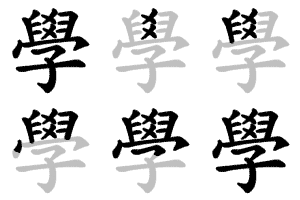
學
- to study, to learn;
- learning, teaching;
Etymology
Originally written 斅 (효, to teach), closely related to 敎 (교, to instruct).
敎 (to teach) supplies the semantic component, indicating teaching or instruction.
臼 (mortar) provided the phonetic element.
Over time, the character evolved: in some forms, the lower 子 (child) element was added to emphasize the image of a child receiving instruction, creating the familiar 學 form.
Semantic range:
- to study, to learn;
- to teach, instruction;
- learning, knowledge, scholarship;
- school, academic pursuit.
Usage in Korean
학교 (學校) — school
학문 (學問) — learning, scholarship
과학 (科學) — science
음악 (音樂) — music (lit. “organized sounds of learning”)
유학 (留學) — studying abroad
수학 (數學) — mathematics
Additional notes
In Traditional Chinese (used in Korea, Taiwan, Hong Kong) the character is written 學.
In Simplified Chinese and Japanese Shinjitai, it is reduced to 学.
Korea also once experimented with 学 as a shorthand form, and in handwriting the simplified form is still common.
In Confucian philosophy, 學 (learning) was seen as the foundation of moral cultivation and self-improvement.
The Analects of Confucius open with the famous line:
學而時習之, 不亦說乎
“To study and constantly practice what one has learned — is this not a joy?”
Here, 學 implies not only acquiring knowledge but embodying it through practice (習). Thus, 學 in East Asian thought extends beyond formal study: it represents a lifelong path of self-cultivation, moral development, and participation in cultural tradition.
Alternative forms
A rare historical shorthand form is 斈.
- 竹月弓木 (HBND)
- ⿱ 𦥯 子