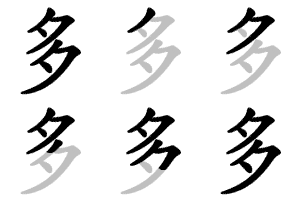
多
- many, a lot of;
By extension, it developed meanings like “excessive, overdone” (심하다, 지나치다).
Etymology
A compound ideograph.
The character shows two 夕 (evening) components tilted, but it has no actual relation to “evening.” 多 originally depicted two pieces of meat and came to mean “many” or “numerous.”
Oracle bone script (甲骨文) depicted as two shapes resembling ᄇ, lying side by side. This symbol actually represented 肉 (meat) in oracle bone script. This form remained largely unchanged through time and eventually became 多.
Semantic development:
- many / much
- numerous / abundant
- excessive / too much
- severe or intense (derived sense)
Thus, 多 can imply not only quantity but also degree.
Usage in Korean
다수 (多數) — a large number; majority
다량 (多量) — large quantity
과다 (過多) — excess; too much
다언 (多言) — talkative
Alternative forms
𢑑 — an ancient variant written as two pig heads stacked together.
夛 — a hybrid form between the ancient character and the modern shape.
- 弓戈弓戈 (NINI)
- ⿱ 夕 夕