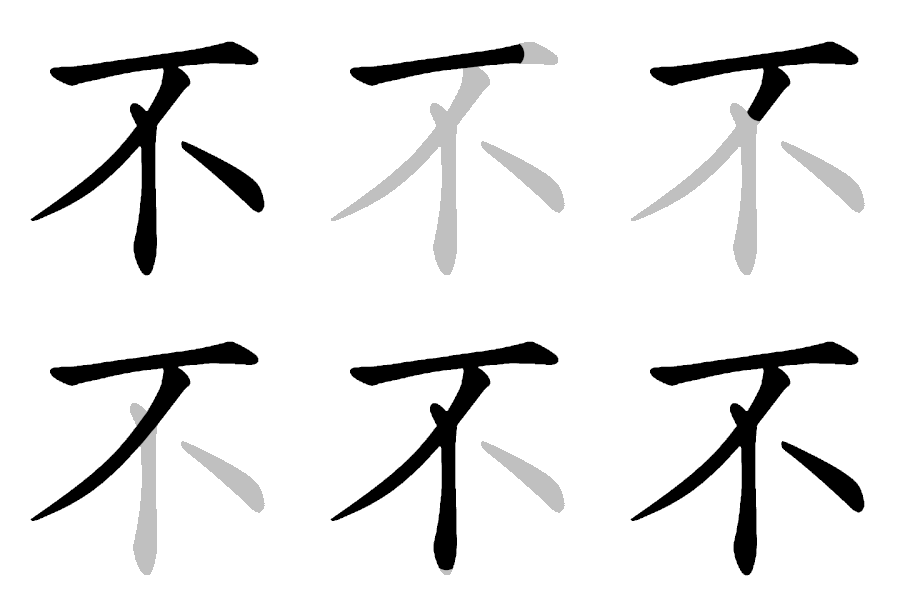
不
- not;
- no;
- non-;
Etymology
不 is one of the oldest characters in Chinese writing.
The exact origin of 不 is uncertain. In oracle-bone and bronze inscriptions, 不 appears as a simple pictographic form, likely representing a concrete object and later borrowed phonetically to express negation.
Over time, its original concrete meaning disappeared, and 不 became purely grammatical, functioning as a general negative marker.
Unlike most characters, 不 does not retain a clear semantic radical–phonetic structure in its modern usage.
Shuowen Jiezi (説文解字) describes it as a bird flying upward and not descending — interpreted as “not returning,” hence “not.”
Other theories:
- flower calyx (柎의 본자);
- plant root representation.
Usage in Korean
不 is primarily a negating adverb or prefix, used to deny:
- actions
- states
- qualities
- existence (in certain contexts)
It is placed before verbs, adjectives, or verb phrases.
It is one of the most basic and frequently used negation characters in Classical and Modern Chinese, as well as in Korean and Japanese.
Common compounds:
불가 (不可) — impossible
불법 (不法) — illegal
불필요 (不必要) — unnecessary
불만 (不滿) — dissatisfaction
불행 (不幸) — misfortune
Additional notes
不 is part of a family of negative characters with slightly different nuances:
無 — not, none, does not exist (absolute absence, like no / none);
未 — not yet (temporal negation, e.g. 未來 “future” = not yet come);
弗 — originally “not,” but rarely used now except in words like 弗 (dollar) or 불소 (fluoride);
非 — wrong / not in accordance with (denial of category or quality; implies wrongness);
否 — to refuse, to reject (used when actively saying “no” or recording rejection, e.g. 가/부 표 in voting);
勿 — must not (prohibition).
Among these, 不 is the most general-purpose and neutral negative marker.
Classical citations:
《論語》 (The Analects)
「知之為知之,不知為不知」
“To know what you know, and to say you do not know what you do not know.”
《孟子》 (Mencius)
「不可不察也」
“It cannot be left unexamined.”
Words that derived from 不
- 고집불통(固執不通)–being headstrong; being willful
- 과부족(過不足)–excess and deficiency
- 꼴불견(꼴不見)–shabbiness; indecency; ugly scene
- 부단히(不斷히)–continuously; ceaselessly; constantly
- 부당(不當)–injustice; being unfair; being wrongful
- 부도(不渡)–bankruptcy
- 부도덕(不道德)–being immoral; being unethical
- 부도덕하다(不道德하다)–immoral; unethical
- 부동(不動)–being immovable; being immobile; being unshakable; being unchallenged
- 부동산(不動産)–property; real estate; real estate agent
- 부득이(不得已)–unavoidably; inevitably
- 부등식(不等式)–inequation
- 부실(不實)–weakness; feebleness; poorness
- 부자유(不自由)–restriction; lack of freedom
- 부재(不在)–absence
- 부적격(不適格)–being unqualified
- 부적격자(不適格者)–unqualified person
- 부적응(不適應)–maladjustment
- 부적합(不適合)–being unsuitable; being unfit; being inappropriate
- 부정부패(不正腐敗)–corruption
- 부정확(不正確)–inaccuracy; incorrectness
- 부정확하다(不正確하다)–inaccurate
- 부조리(不條理)–irregularity; unreasonableness
- 부조화(不調和)–disharmony
- 부족(不足)–shortage; lack
- 부족하다(不足하다)–insufficient; inadequate
- 부주의(不注意)–carelessness
- 부진(不振)–sluggishness
- 불가(不可)–wrong; impossibility
- 불가결(不可缺)–indispensability
- 불가능(不可能)–impossibility
- 불가능하다(不可能하다)–impossible
- 불가분(不可分)–indivisibility
- 불가하다(不可하다)–wrong; impossible
- 불과(不過)–only
- 불과하다(不過하다)–only; just; mere; nothing but
- 불구(不具)–deformity
- 불규칙(不規則)–irregularity
- 불규칙하다(不規則하다)–irregular
- 불능(不能)–inability; incapableness; impotence; sterility
- 불능하다(不能하다)–incapable
- 불량(不良)–misconduct; misbehavior; poorness; defective product
- 불리(不利)–disadvantage
- 불리하다(不利하다)–disadvantageous
- 불만(不滿)–dissatisfaction
- 불만족(不滿足)–dissatisfaction
- 불면(不眠)–sleeplessness; insomnia
- 불멸(不滅)–immortality; imperishability
- 불명(不明)–being unknown; indecent behavior
- 불명예(不名譽)–dishonor; disgrace; shame
- 불법(不法)–illegality; unlawfulness
- 불변(不變)–invariability; unchangeability
- 불사(不辭)–not avoiding; being willing to
- 불신(不信)–distrust
- 불안(不安)–uneasiness; anxiety; uncertainty; insecurity
- 불완전(不完全)–imperfection; incompleteness
- 불응(不應)–noncompliance; disobedience; refusal
- 불의(不義)–injustice; unrighteousness
- 불이익(不利益)–disadvantage; penalty; detriment
- 불초(不肖)–I; me
- 불쾌(不快)–being unpleasant; displeasure; discomfort
- 불통(不通)–being cut-off; being out of service; being down
- 불편(不便)–inconvenience; discomfort; awkwardness
- 불편하다(不便하다)–inconvenient; uncomfortable; awkward
- 불평(不平)–complaint; grumbling
- 불평등(不平等)–inequality; disparity
- 불합리(不合理)–being unreasonable; being illogical
- 불행(不幸)–unhappiness; misery; difficulty
- 불행하다(不幸하다)–unhappy; unfortunate
- 불효(不孝)–not being filial
- 불효자(不孝子)–undutiful child; unfilial child
- 신토불이(身土不二)–belief that domestic farm products are the best
- 영원불멸(永遠不滅)–immortality; perpetuity
- 영원불변(永遠不變)–eternity
- 정체불명(正體不明)–being mysterious; being unidentified
- 철부지(철不知)–child; immature person
- 一火 (MF)
- ⿸ 丆 ⿰ 丨 丶 (G H J K T)
- ⿻ 丆 卜 (V)