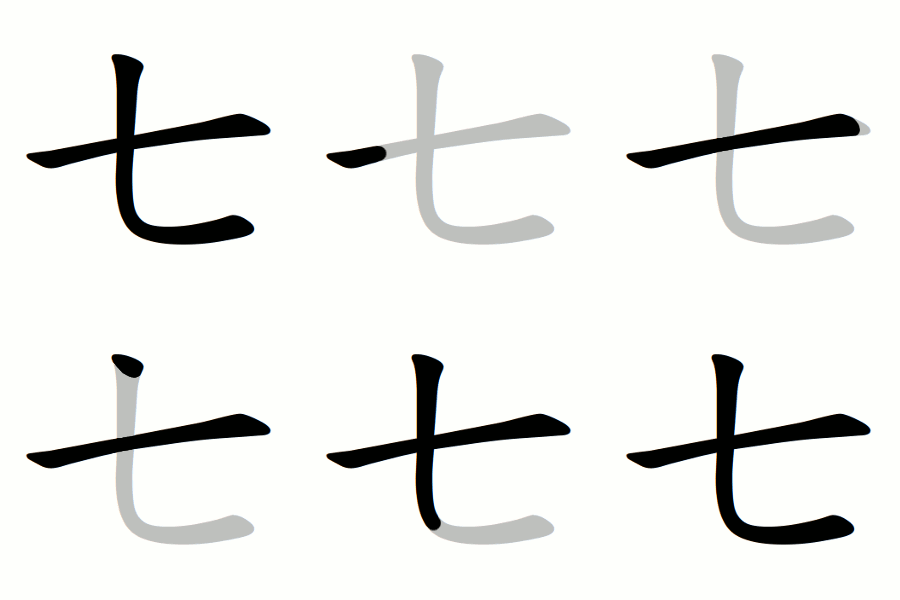
七
- seven, number 7, seventh;
Etymology
A pictograph / borrowed numerical symbol.
Originally, the character for "to pierce" or "to cut" was 十 ("ten"), but since it was written with a vertical stroke and became confused with the horizontal stroke of the character for "ten," a curved vertical stroke was used instead, creating 七, which was later loaned to represent the number 7. The original meaning was preserved by combining it with 刀 ("knife") to create 切 ("to cut").
There’s also a theory that the character 七 originated from the image of intestines spilling out, derived from the Chinese use of 十 to symbolize ritual disembowelment (harakiri-like acts). This suggests that 七 may have evolved from that symbolism.
Usage in Korean
칠월 (七月) — July
칠일 (七日) — seven days
칠십 (七十) — seventy
칠성 (七星) — seven stars
Additional notes
七 is one of the simplest basic numerals.
Although graphically simple, 七 carries strong cultural symbolism:
- ritual cycles;
- seasonal observances;
- philosophical classifications.
It demonstrates how early Chinese writing used simple marks to represent abstract numerical concepts.
In East Asia, seven is associated with:
七夕 — Qixi Festival
七宝 — seven treasures
七情 — seven emotions
It can symbolize:
- completeness;
- cycles;
- spiritual numerology.
Related characters:
一 — one
二 — two
三 — three
十 — ten
It has variant or associated characters, such as 柒. Originally, 柒 meant "lacquer" (옻 칠), but because it contains 七 as a component and has a similar pronunciation, it came to be used as a variant form. In some place names, like Chilgok-gun (칠곡군), the character 漆 is used instead of 柒.
Although rare, there are a few Chinese characters where 七 is used as a side component. A representative example is 切 (to cut, 끊을 절).
Words that derived from 七
- 十山 (JU)
- ⿻ ㇀ 乚 (G H J K V)
- ⿻ ㇀ ㇄ (T)