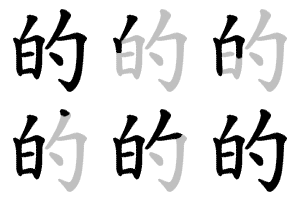
的
- target;
- (possessive or attributive particle) -ive, -like, -ish, -ic, -ical, -y, kind of, sort of;
The hanja 的 originally meant “target” but also carries the meanings of:
• a possessive or attributive particle (like “~의” in Korean, or “’s” in English);
• a suffix meaning “-like,” “-ic,” or “-al,” indicating a certain quality or state.
Etymology
A phono-semantic compound:
白 (white) — semantic component, originally referring to the white center of a target
勺 (작, “ladle/scoop”) — phonetic component, provides pronunciation
In ancient archery, the white center of the target was called 的. From the idea of precision and exactness, the meaning expanded metaphorically.
《說文解字》 (Shuowen Jiezi):
「的,明也。」
“的 means clarity / distinctness.”
Usage in Korean
In Korean, 的:
- does not function as a grammatical particle
- appears mainly in Sino-Korean nouns and adjectives
- retains its semantic core of “target / exactness”
The Chinese grammatical function of 的 is instead handled by:
- 의 (possessive)
- adjective endings (-한, -적인)
목적 (目的) — purpose; objective
표적 (標的) — target (military / figurative)
적중 (的中) — hitting the mark; accuracy
지적 (指摘) — pointing out; indication
객관적 (客觀的) — objective
주관적 (主觀的) — subjective
기본적 (基本的) — basic
일시적 (一時的) — temporary
사실적 (寫實的) — realistic
Additional notes
Related characters:
目 — eye; focus
標 — mark; sign
中 — hit; center
白 — clarity; brightness
的 is the most frequently used character in modern Chinese. Its grammatical role developed long after its original concrete meaning.
The concept of precision → relation → description explains its semantic evolution.
Korean and Japanese borrowed the adjectival sense, not the grammatical particle.
Classical citations:
《史記》 (Records of the Grand Historian)
「射不中的。」
“He shot but did not hit the target.”
《莊子》 (Zhuangzi)
「失其的矣。」
“He has lost the target” — lost the point or essence.
Words that derived from 的
- 竹日心戈 (HAPI)
- ⿰ 白 勺