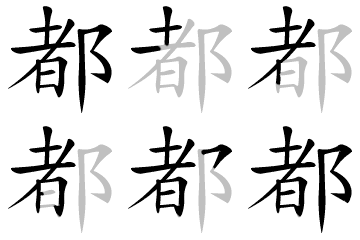
都
- capital city, metropolis;
- all, completely, entirely;
Etymology
Phono-semantic compound:
邑 (고을 읍) — semantic, “settlement, town.”
者 (놈 자) — phonetic, giving the sound dū and suggesting “person, community.”
The original sense was the principal city among many towns (邑) — a capital that gathers and governs all subordinate places.
From this sense of “central gathering place,” the secondary meaning “all; together” naturally developed.
Usage in Korean
The character 都 has two principal meanings:
Capital or metropolis — a main city that governs other towns or settlements.
도읍(都邑) — capital city
도시(都市) — city, urban area
All; Entirely; Altogether — used adverbially to mean “everyone,” “everything,” or “completely.”
모두(都) — all, everyone
자룡一身都是膽也 — “Zilong’s entire body is courage”
It also appears as a prefix meaning “chief” or “head,” as in 도원수(都元帥) “supreme commander,” 도승지(都承旨) “chief royal secretary.”
Additional notes
In early Chinese civilization, 都 denoted the chief administrative city of a state — the seat of rulers and the center of ritual and governance.
In Confucian and historical texts, 都 represented civilization and order, in contrast to the rural or tribal periphery.
Later, the meaning extended figuratively to “the whole, the entirety,” just as the capital symbolically encompassed its realm.
Hence, expressions like 皆是都 (all are the same) or 都好 (all good) preserve that inclusive sense.
In Korean, the term appears in both classical compounds (e.g., 도읍, 도성) and in modern vocabulary like 수도(首都, capital).
Alternative forms
嘟, 𢵋, 𨗊, 𣛭, 𡳤, 𨅮, 𩼁, 𡳣, 𡼞, 𡳢, 𥳉, 𧹼
- 十日弓中 (JANL)
- ⿰ 者 阝