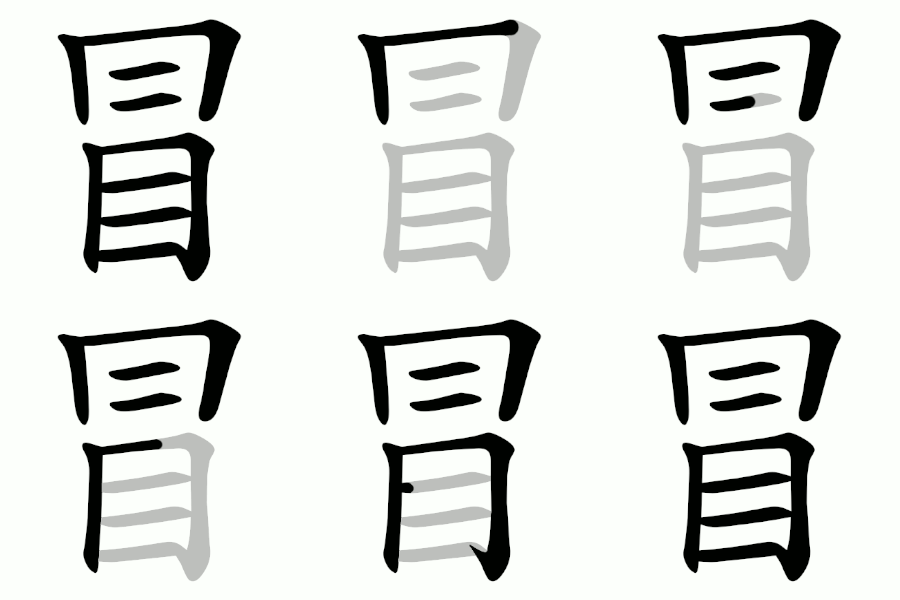
冒
- to risk;
- to brave;
- to assume falsely;
- to cover;
Etymology
Originally a pictographic character depicting a head covered with a cap or hat (冃).
This image led to meanings like:
“to cover” → wearing something;
“to take on” → assuming identity or risk.
Over time, the meaning expanded metaphorically into:
- risking something (placing oneself under danger);
- impersonating (covering one’s true identity).
Historical development:
The character appeared as early as the mid–Western Zhou period.
The original meaning related to headgear, which later split into:
帽 — hat (specialized meaning);
冒 — abstract meanings (risk, impersonation).
The top component 冃 represents a head covering and is often confused with shapes like 日 or 曰.
Semantic development:
- wearing a covering (hat);
- covering or placing over;
- taking something upon oneself;
- risking or daring;
- assuming identity (impersonation).
Thus, 冒 evolved from physical covering to abstract assumption and risk.
Usage in Korean
모험 (冒險) — adventure; risk-taking
모독 (冒瀆) — insult; affront
모칭 (冒稱) — false claim; impersonation
Additional notes
The phrase 冒姓, 모성 (maternity) historically referred to taking another family name, often viewed as improper or deceptive.
In modern Chinese, 冒 is widely used in everyday expressions like 冒险 (to take risks).
The character illustrates how a simple image (a hat) can evolve into complex meanings like identity, risk, and assumption.
The top component 冃 is distinct and should not be confused with 日 or 曰.
Related characters:
帽 — hat (derived specialized form)
覆 — to cover
假 — to pretend; to assume
犯 — to risk; to commit
Among these, 冒 uniquely combines risk-taking and false assumption, rooted in the idea of “covering.”
Words that derived from 冒
- 日月山 (ABU)
- ⿱ 日 目 (J)
- ⿱ ⺜ 目 (G T K V)