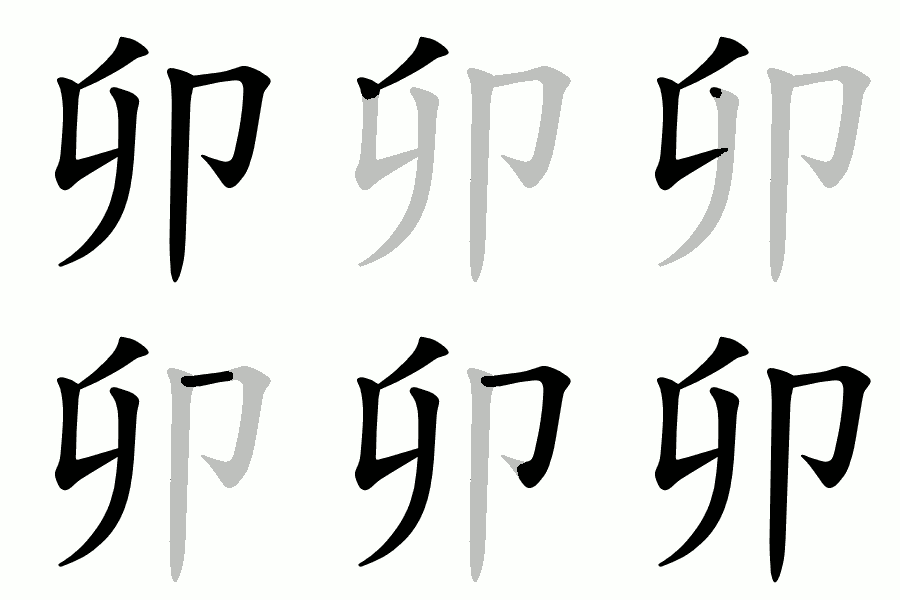
卯
- rabbit;
- the fourth Earthly Branch;
The fourth of the Twelve Earthly Branches (地支). It is primarily used in sexagenary cycle notation, calendrical systems, astrology, and cosmology, and symbolically represents the rabbit.
Etymology
Original character: 戼 (the true original form)
Later forms: 卯 (common form), 夘 (variant)
卯 is historically a simplified or popularized form, while 戼 is regarded as the original character.
Traditional explanations:
Shuowen Jiezi (說文解字) explains 卯 as a pictograph of double doors opening outward, symbolizing opening, division, or separation.
Alternative historical interpretation:
Some oracle-bone inscriptions (甲骨文) research suggests that 卯 originally depicted a Shang-dynasty punishment involving splitting the human body in two.
This practice is believed to have disappeared by the Zhou dynasty, and the character later underwent semantic re-interpretation.
Usage in Korean
Appears in:
- calendrical dating
- astrology (saju / bazi)
- historical era names
- sexagenary year notation
Rarely used alone in modern language outside technical or classical contexts.
Additional notes
卯 is the fourth Earthly Branch.
Symbolizes the rabbit, spring growth, and Wood energy.
Deeply connected to calendrical, astrological, and cosmological systems.
Originated as a pictographic symbol of division or opening.
Rich in Five-Elements and sexagenary symbolism.
Position in the Twelve Earthly Branches:
1 — 子 — Rat
2 — 丑 — Ox
3 — 寅 — Tiger
4 — 卯 — Rabbit
5 — 辰 — Dragon
Cosmological attributes (Traditional East Asian Thought):
Elemental correspondence
Five Elements: Wood (木)
Heavenly Stem affinity: 乙 (Yin Wood)
Symbolic imagery
- Rabbit
- Young plants, sprouts
- Flowers, grass, weeds
- Early growth and expansion
Colors
- green
- light green
- blue-green
Hidden Heavenly Stems (地藏干):
甲 (Yang Wood)
乙 (Yin Wood)
Traditional lunar assignment
Lunar Jan 25 – Feb 5: 甲 Wood governs
Lunar Feb 6 – Feb 25: 乙 Wood governs
Sexagenary cycle combinations containing 卯:
乙卯 — 大溪水 (Great Valley Water) — rivers, streams, large flowing water
丁卯 — 爐中火 (Fire in the Furnace) — inner warmth, endurance against cold
己卯 — 城頭土 (City-Wall Earth) — fortifications, authority, boundary zones
辛卯 — 松栢木 (Pine and Cypress Wood) — evergreen vitality, resilience
癸卯 — 金箔金 (Gold Foil Metal) — thin gold, crowns, outer brilliance with inner emptiness
- 竹竹尸中 (HHSL)
- ⿰ 𠂎 卩